

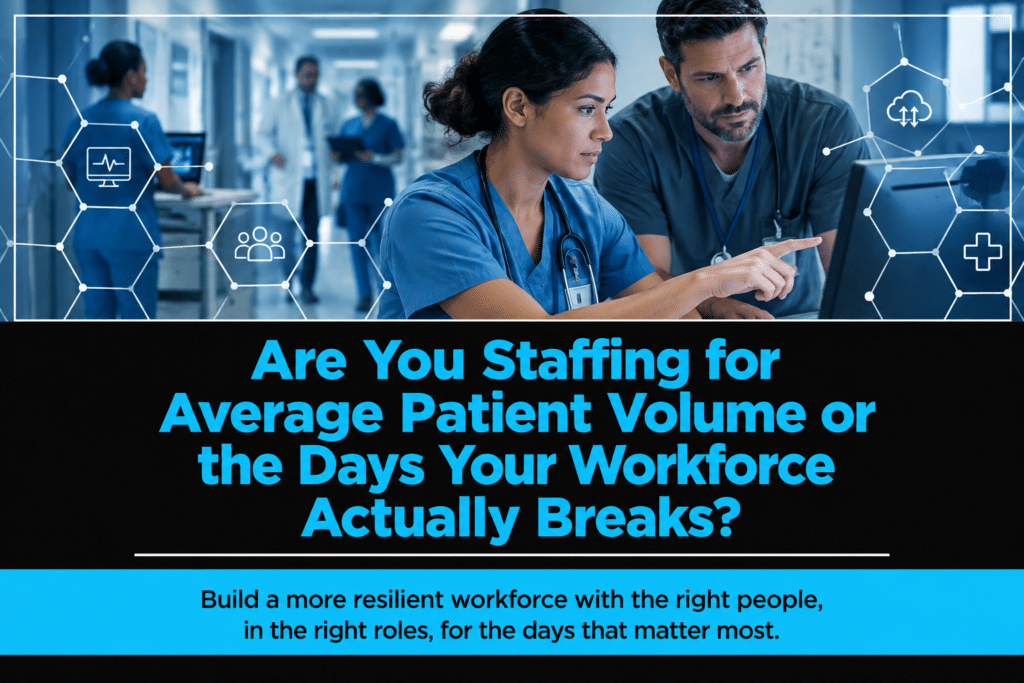
Hospital staffing plans built around average patient volume can look adequate on paper and still fail on the days that matter most.
A unit may appear appropriately staffed across a month or quarter while repeatedly experiencing shorter periods when admissions rise, acuity increases, call-outs overlap, or patient flow slows. Those peaks are when overtime increases, managers scramble for coverage, and the permanent team is asked to absorb more than the staffing model anticipated.
For hospital operations and workforce leaders, the question is not simply whether staffing matches average census. It is whether the workforce has enough flexibility to handle the predictable and unexpected peaks that put the greatest pressure on operations.
Average Census Can Hide the Hardest Days
Averages are useful for understanding overall volume, but they smooth out the variation that employees actually experience.
A Unit Can Look Properly Staffed and Still Struggle Repeatedly
Imagine a medical-surgical unit that averages a manageable census across the month.
Monday through Thursday may operate comfortably. Then admissions increase heading into the weekend, several higher-acuity patients remain on the unit longer than expected, and one employee calls out.
The monthly average has barely changed.
The staffing reality has.
That distinction matters because workforce pressure is often created by the concentration of demand, not simply the total amount of demand over time.
If the same unit repeatedly relies on overtime, float staff, additional shifts, or last-minute coverage during certain periods, leaders should look beyond the average and ask whether those peaks are actually predictable.
Census Is Only One Measure of Workload
Two shifts with the same number of patients can require very different levels of staffing support.
Patient Volume Does Not Always Equal Patient Workload
A census of 25 patients with relatively stable needs is not operationally identical to 25 patients with multiple admissions, discharges, transfers, higher acuity, or complex care requirements occurring during the same shift.
The surrounding workflow matters too.
Diagnostic delays, pharmacy needs, respiratory care, patient transport, discharge coordination, and other dependencies can increase the workload on a unit without dramatically changing its census.
That is why looking at headcount against patient volume alone can leave leaders wondering why a unit that appears adequately staffed continues to generate overtime and coverage requests.
The better question is what is happening during the shifts when staffing pressure is highest.
Overtime Can Reveal Where the Staffing Model Is Breaking
Overtime is often viewed primarily as a labor cost. It can also be a useful signal of where staffing capacity and actual demand are no longer aligned.
Look at Where Overtime Is Concentrated
Occasional overtime does not necessarily indicate a workforce problem.
Repeated overtime on the same unit, shift, or day of the week deserves more attention.
If weekend coverage consistently requires additional hours, the issue may not be an unpredictable weekend surge. It may be a recurring staffing need that the baseline schedule does not adequately address.
The same applies when certain employees are repeatedly asked to pick up extra shifts. A unit may technically maintain coverage while depending on the same group of people to make the staffing model work.
Over time, that approach can create another problem: the employees carrying the extra workload may become the ones most at risk of leaving.
Some Staffing Peaks Are More Predictable Than They Look
Hospitals cannot predict every call-out, admission, or change in acuity. But that does not mean every staffing surge is unexpected.
Look for Patterns Before Calling It an Emergency
Seasonal illness, holiday PTO, weekend admissions, elective procedure schedules, planned leaves, historically difficult shifts, and recurring census patterns can all provide advance warning.
Healthcare organizations should also look at what happens immediately before and after predictable events.
For example, the staffing challenge may not occur during a holiday itself. Diagnostic services or procedural areas may experience increased demand when normal schedules resume and delayed work moves back into the system.
If the same staffing problem appears at roughly the same time every week, month, or year, it should eventually stop being treated as a surprise.
Build Flexibility Around the Peaks
Planning for peak demand does not mean maintaining maximum staffing every day.
That would create a different efficiency problem.
Instead, healthcare leaders need to understand where baseline staffing is sufficient and where additional flexibility may be necessary.
Match the Staffing Solution to the Pattern
Different workforce problems require different responses.
A recurring permanent vacancy may call for a stronger direct-hire recruiting strategy.
A predictable seasonal increase may be better supported through temporary or travel professionals.
A short-term leave may require coverage for a defined period.
An unexpected increase in volume may require access to flexible staffing resources that can supplement the permanent workforce.
Internal float pools, cross-trained employees, per diem professionals, travel staff, and other contingent resources can all play different roles depending on the organization and the situation.
The objective is not to rely on temporary staffing every time demand increases. It is to avoid making overtime and last-minute scrambling the only available response.
Watch for the Difference Between a Peak and a Permanent Problem
Temporary staffing pressure and chronic understaffing should not be treated the same way.
Repeated Peaks May Be Telling You Something Bigger
If a unit regularly requires additional coverage regardless of season or unusual patient volume, the organization may not have a peak-demand problem anymore.
It may have a permanent workforce gap.
That is when leaders should examine vacancy levels, turnover, scheduling, compensation, difficult-to-fill shifts, recruiting reach, and whether baseline staffing assumptions still reflect current operations.
Flexible staffing can provide necessary support while those issues are addressed, but it should not prevent leaders from identifying why the same gaps continue to return.
Plan for the Days That Put the Most Pressure on Your Team
Averages still have a place in healthcare workforce planning. They simply should not be the only measure.
Look at the days and shifts when the organization struggles most.
Where does overtime spike? Which units repeatedly request additional coverage? When are managers rebuilding schedules at the last minute? Where does a single call-out create an outsized problem? Which demand spikes happen often enough that they should already be part of the staffing plan?
Those patterns can reveal where additional workforce flexibility will have the greatest operational value.
Build More Flexibility Into Your Healthcare Staffing Strategy
Your permanent workforce should not have to absorb every increase in patient demand.
Bluebird Staffing helps hospitals and healthcare organizations access experienced nursing, allied health, healthcare IT, and other healthcare professionals when additional workforce capacity is needed.
Whether you are preparing for predictable seasonal demand, managing difficult-to-fill vacancies, or seeing the same units repeatedly struggle during peak periods, our recruiters can help you find talent aligned with your specific needs.
If your staffing plan works on an average day but struggles when demand rises, contact Bluebird Staffing today to discuss your workforce needs.