
For CNOs, nursing directors, and workforce planning managers quietly tracking how many seasoned nurses are within five years of retirement, this conversation cannot wait. Nursing shortage’s impact on hospitals is not a simple headcount problem. It is a structural knowledge crisis that new-graduate hiring alone cannot solve.
The Experience Cliff Is Already Here
Most hospitals underestimate how concentrated institutional knowledge actually is. A unit with 30 nurses on the roster might have four or five people carrying a disproportionate share of its working memory, from knowing how a particular attending prefers to be paged to managing supply workarounds that never made it into the EHR workflow.
Consider a pattern playing out across mid-sized regional hospitals: roughly a third of nursing staff is over 55. Leadership knows retirements are coming but has focused hiring on new graduates. Then, within 18 months, six experienced ICU nurses retire in the same fiscal year. The unit does not lose six employees. It loses cumulative decades of crisis pattern recognition, preceptor capacity, and informal mentoring relationships that newer nurses depended on without fully realizing it.
What Actually Walks Out the Door
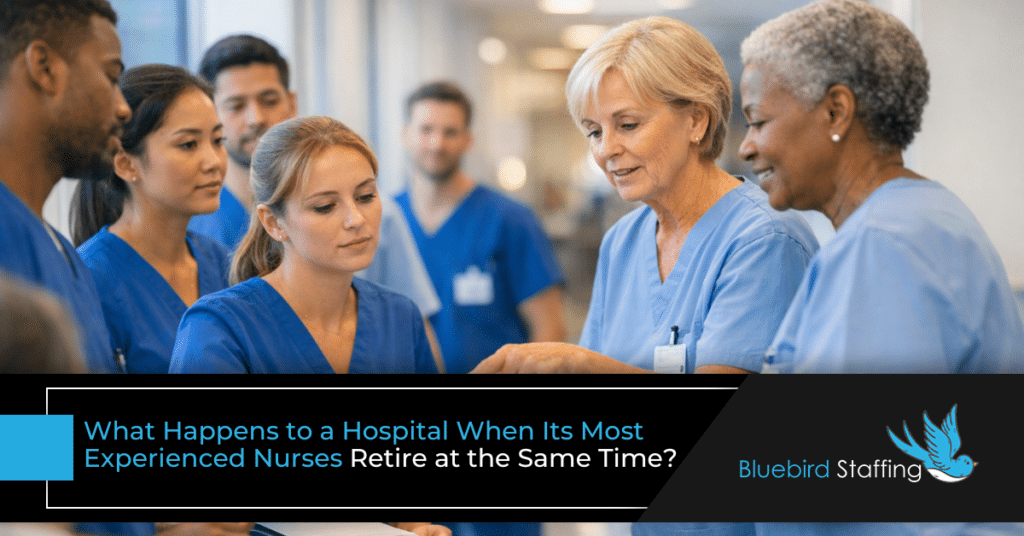
Institutional knowledge in nursing is not stored in an EHR. It lives in people. When experienced nurses retire simultaneously, hospitals lose clinical pattern recognition built through years of patient contact, unit-specific workarounds that exist alongside official protocols, and coordination networks that keep care moving, such as knowing which pharmacy tech responds fastest or how to navigate a tense interdisciplinary handoff without causing delays.
Most critically, hospitals lose preceptor capacity. When experienced nurses retire in a cluster, the pipeline for orienting new hires collapses at the exact moment the bed census still demands full staffing.
The Mentorship Gap Nobody Planned For
Picture a newly licensed nurse joining a busy medical-surgical unit six months after three of its most senior nurses retired. There is no structured orientation beyond the basics, the charge nurse is stretched thin, and the informal guidance network those retirees provided no longer exists. Without that support, this nurse struggles to recognize the subtle deterioration cues that experienced colleagues would have caught immediately.
This plays out across the country. New nurses land on understaffed units, ramp-up periods stretch longer, near-miss events climb, and first-year attrition rises, compounding the nurse shortage impact on hospitals already under significant pressure.
What Hospitals Can Do Before the Gap Opens
The facilities managing this well are not waiting for retirement notices. Here is what a practical response looks like:
Audit retirement risk by unit, not just total headcount. Map which units have the highest concentration of nurses within five to seven years of retirement, and identify which clinical functions would be exposed if those nurses left this year.
Capture knowledge before departure. Structured conversations with experienced nurses, including recorded sessions archived for charge nurses, preserve informal protocols that would otherwise disappear entirely.
Build intentional overlap periods. Where timelines allow, pair a retiring nurse directly with their replacement for several weeks. Phased retirement programs extend this window without requiring experienced nurses to stay on indefinitely.
Bring in experienced travel nurses during transitions. When retirements outpace internal succession planning, working with a healthcare and travel nurse staffing agency gives hospitals access to clinically experienced nurses who can work independently of their first shift while the permanent team rebuilds.
Start with your retirement risk map this month. Flag every nurse within seven years of retirement eligibility by unit, and determine whether you are managing a gradual transition or already facing an urgent gap.
Ready to Stabilize Your Nursing Units Through a Retirement Transition?
Bluebird Staffing connects hospitals and health systems with experienced nurses, including travel nurses who bring clinical depth from their first shift. If your units are facing knowledge gaps from pending or recent retirements, contact Bluebird Staffing to discuss placement options that match your timeline, unit needs, and patient acuity.