
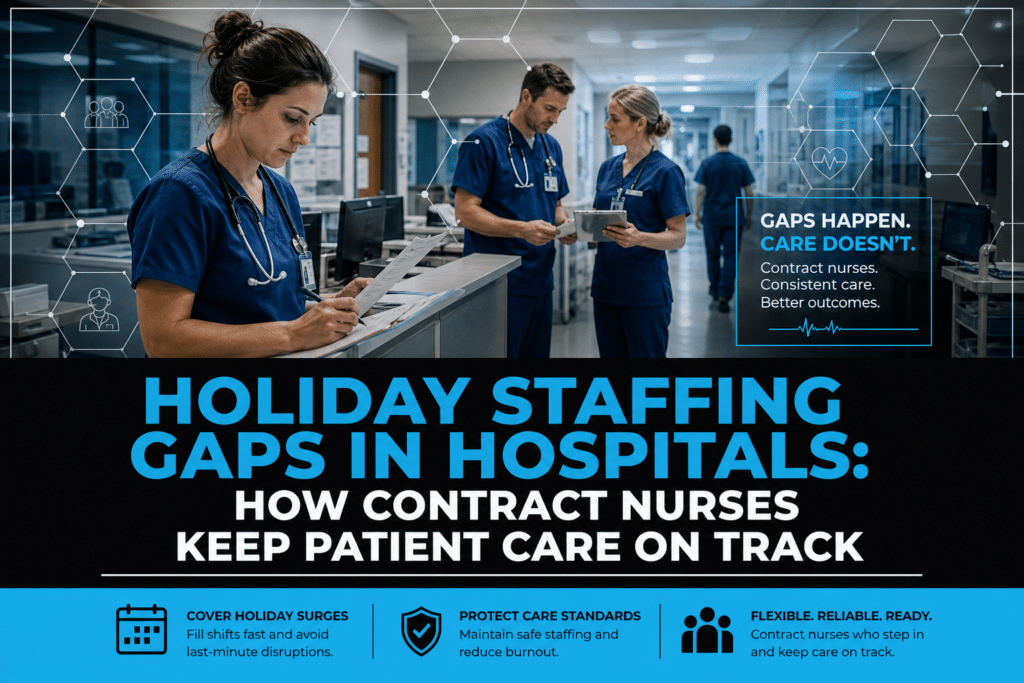
Thanksgiving week has a way of exposing a staffing plan that looked fine in October. A unit that was fully scheduled on paper suddenly has three PTO requests approved for the same stretch, a respiratory admission curve that bends upward, and a float pool already committed elsewhere. The charge nurse is building the schedule by hand at 6 a.m., and patient care is what absorbs the strain.
In our experience, the units hit hardest over the holidays are rarely the ones that were short on paper in November. They are the ones where scheduled leave, a seasonal illness surge, and a single unfilled position all land in the same two weeks. Planning for that overlap is where contract nurses earn their place.
Why the Holiday Gap Opens Before the Calendar Says It Should
Most holiday shortfalls begin with approvals made months earlier. Staff request time off for the holidays in the early fall, managers approve requests in order, and by the time anyone looks at the full grid, the coverage math has already tilted. Nobody did anything wrong. The schedule simply was not built to absorb a second pressure point.
The gap widens when a vacancy is already open going into the season. A position that has been posted for six weeks, with no qualified candidates in sight, turns every approved absence into a real coverage problem. This is especially true for specialty roles such as OR staff nurses and RN First Assists, where a float from a general med-surg unit is not a like-for-like substitute.
Where PTO Coverage Usually Breaks Down
When we look at how holiday coverage fails, the same few points come up again and again:
- Approved PTO clusters around the same two or three dates, usually the week of Thanksgiving and the days between Christmas and New Year’s.
- Float pool staff are pulled to cover vacancies in other departments, leaving the home unit thinner than the schedule suggests.
- Specialty vacancies that were never filled stay on the grid as “covered by internal staff,” which hides the real exposure.
- Orientation for any replacement is compressed, so a new nurse on night shift may be working without a full picture of the unit’s workflows.
Each of these is manageable on its own. Together, during a census spike, they can push a unit past its safe staffing ratio before anyone formally flags it.
The Flu and RSV Surge Arrives on Top of Scheduled Leave
Flu and RSV season does not wait for the holiday calendar. Respiratory admissions tend to rise through the late fall and winter, which means the units absorbing those patients are often the same ones trying to cover PTO. Imagine a medical-surgical unit where two experienced nurses are out on approved leave the week before Thanksgiving, and a third calls in with a family illness. The charge nurse now has a patient load that requires more hands than the schedule shows, and no internal float is available. This scenario is illustrative, but versions of it play out in hospitals every winter.
Contract nurses address that moment directly. A travel or local contract clinician can be placed to cover a defined assignment, often in a 13-week block, which gives the unit stable coverage through the peak rather than a series of single-shift scrambles. For facilities that also need to consider how peak demand should shape staffing decisions year-round, our piece on Hospital Peak Staffing Strategies: Are You Staffing for Average Patient Volume or the Days Your Workforce Is Tested? walks through how to plan for those high-census days before they arrive.
How Contract Nurses Fill the Gap Without Lowering the Bar
The concern we hear most from nurse managers is simple: will a contract nurse actually be ready for this unit? That concern is fair, and it is the reason the vetting process matters more than the speed of placement. At Bluebird Staffing, every candidate goes through in-depth interviews, background checks, and reference verification before a hospital sees a profile. Recruiters also prescreen for the specific unit environment, so a nurse placed for OR coverage has the right experience for an OR, not just a matching license.
Speed still matters during the holidays. A vacancy that sits open into December is a problem that compounds with each shift. Working with a recruiter who answers quickly and keeps the process moving from the first call through onboarding is how a unit closes the gap while the census is still climbing.
What to Ask Your Staffing Partner Before the Holidays
Before you commit to a holiday assignment, get clear answers on these points:
- The specific unit, shift, and schedule the contract nurse will work, including any on-call expectations.
- Credential and competency requirements for the role, verified before the start date rather than during orientation.
- How the agency handles a no-show or early departure, and who you call at night when a problem comes up.
- Whether the recruiter who placed the clinician stays involved through the assignment.
Those answers tell you more about coverage reliability than any rate sheet.
Trade-Offs to Plan For
Contract staffing is not the right answer for every holiday gap. A one-shift shortfall that can be covered by a willing internal nurse is usually simpler to handle internally. Contract clinicians also need orientation time, and a nurse who has never worked your EHR or your unit’s escalation pathways will be less efficient in the first few shifts. Teams that get the most from contract coverage start the conversation early, before the schedule is already in crisis. For a broader comparison of when each model fits, see Travel Nurses vs. Permanent Nurses: How Should Hospitals Decide?
Lock In Holiday Coverage Before the Calendar Fills
Thanksgiving is a good moment to think about who is covering the floors while everyone else is at the table. Nurses and clinicians working the holidays keep patients safe on the days when staffing is thinnest, and the units that get them through that stretch usually started planning weeks before the first request came in.
If your unit is already seeing PTO overlap, a respiratory surge on the horizon, or an open specialty role that has been posted too long, now is the time to act. Need talent? Bluebird delivers, with named recruiters available around the clock and placements built around your unit’s real needs. Start with Bluebird Staffing’s healthcare staffing services, or call 877-410-5204 to talk through your holiday coverage plan with a recruiter.