For years, healthcare leaders have identified administrative burden as one of the primary contributors to workforce dissatisfaction.
Documentation requirements, repetitive data entry, scheduling complexity, inbox management, and countless non-clinical tasks have consumed valuable time and energy across the healthcare workforce. As artificial intelligence enters the industry, many organizations see an opportunity to finally address these challenges.
And in many cases, they are.
Documentation is becoming faster. Workflows are becoming more automated. Administrative processes are becoming more efficient.
Yet an important question is beginning to emerge.
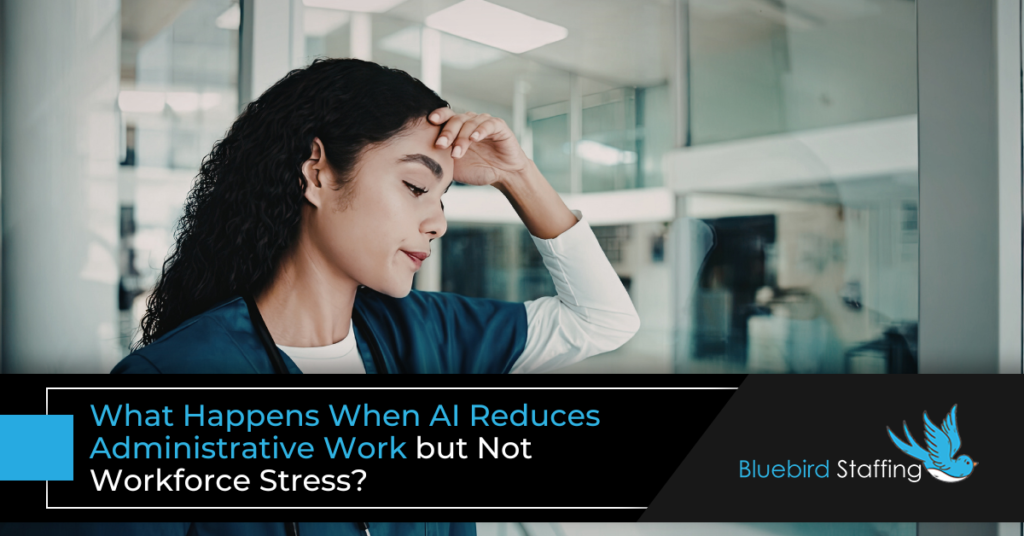
What happens if administrative work decreases, but workforce stress does not?
For some healthcare organizations, that is exactly what they are experiencing.
The Assumption That Efficiency Equals Relief
The promise of AI often centers on efficiency. If clinicians spend less time documenting and more time practicing, job satisfaction should improve. If managers spend less time on administrative tasks, leadership effectiveness should increase.
The logic seems straightforward.
The problem is that administrative burden has never been the only source of workforce stress.
What leaders are discovering
Removing inefficiencies does not automatically address staffing shortages. Faster workflows do not eliminate workforce uncertainty. Automation does not solve issues related to leadership, scheduling, workload distribution, or career growth.
Why this matters
Organizations may achieve operational improvements while seeing little change in engagement, retention, or burnout.
Stress Is Often Rooted in Workforce Design, Not Administrative Tasks
Administrative work is visible. Workforce strain is often less obvious.
Healthcare professionals rarely cite documentation alone as the reason they leave an organization. More often, stress develops from a combination of factors that accumulate over time.
Patient volumes continue to increase. Staffing levels remain inconsistent. Teams absorb vacancies for extended periods. Managers oversee larger teams with fewer resources.
AI may improve workflows, but it does not necessarily change these realities.
The bigger challenge
Many workforce pressures are structural rather than administrative.
Why this matters
Organizations that focus exclusively on efficiency improvements may overlook the factors that influence workforce stability most.
Freeing Up Time Does Not Automatically Improve the Employee Experience
One of the most overlooked questions surrounding AI adoption is what organizations do with the time they create.
In some cases, administrative efficiencies are used to reduce stress and improve capacity. In others, the newly available time is quickly filled with additional responsibilities, productivity expectations, or operational demands.
Employees notice the difference.
What healthcare professionals are asking
Will this technology improve my work experience? Will it help me deliver better care? Will it create more flexibility, or simply increase expectations?
Why this matters
Workforce perception often determines whether technology is viewed as support or surveillance.
Burnout Is Becoming More Complex
Burnout is frequently discussed as a documentation problem, but research and workforce trends suggest it is much broader.
Healthcare professionals increasingly point to emotional exhaustion, lack of control, staffing instability, and organizational disconnect as major contributors to stress.
Many of these issues remain unchanged even as administrative burdens decrease.
What AI cannot solve on its own
Leadership challenges. Workforce shortages. Career stagnation. Cultural issues. Misalignment between employee expectations and organizational priorities.
Why this matters
Technology can reduce friction, but it cannot replace workforce strategy.
The Most Successful Organizations Are Looking Beyond Efficiency
Forward-thinking healthcare leaders are beginning to ask a different set of questions.
Instead of measuring AI solely by time savings, they are evaluating how technology impacts workforce experience, engagement, and retention.
This represents a significant shift in thinking.
What leading organizations are evaluating
Whether employees feel more supported. Whether managers have a greater capacity to lead. Whether technology creates a better work environment rather than simply a faster one.
Why this matters
Long-term workforce success depends on how people experience the organization, not just how efficiently processes operate.
The Real Opportunity Is Workforce Transformation
AI has enormous potential within healthcare. However, its greatest value may not come from automation alone.
The organizations that see the strongest results will likely be those that use AI as a catalyst for broader workforce transformation. They will recognize that reducing administrative work is only one piece of a much larger workforce equation.
Technology can create capacity. Leadership determines how that capacity is used.
At Bluebird Staffing, we work with healthcare leaders who are navigating both workforce challenges and workforce transformation. As organizations rethink staffing models, retention strategies, and employee expectations, our team helps ensure talent strategies evolve alongside operational change.
If your organization is investing in AI but still struggling with engagement, turnover, or workforce stress, it may be time to examine the broader workforce strategy surrounding the technology. Connect with our team to discuss how workforce planning and talent strategy can support long-term success.